
A football formation is the way players are positioned on the pitch before and during a match. A good formation helps a team stay organized, create attacking opportunities, defend effectively, and control different areas of the field. Coaches choose formations based on their players, opponents, tactics, and overall game plan.
There are many types of football formations, and each one has its own strengths and weaknesses. Some formations focus on attacking football, while others provide more defensive stability. Understanding different formations can help players and fans better understand how a football team plays.
What Is a Football Formation?
A football formation describes how the outfield players are arranged on the pitch. The goalkeeper is normally not included when naming a formation. For example, in a 3-4-3 formation, the four defenders, three midfielders, and three forwards make up the formation.A football formation is the basic arrangement of a team’s outfield players on the pitch. To better understand player positions and team structure, you can also learn about the official football rules.You can also learn more about football formation and player positioning from Wikipedia.

Football formations can change during a match. A team may use one formation while attacking and another shape when defending. Modern football often requires players to move into different positions depending on the situation.
Popular Football Formations
4-3-3 Formation
The 4-3-3 formation is one of the most popular football formations. It normally includes four defenders, three midfielders, and three attackers.
This formation can provide a strong balance between attacking and defending. The wide forwards can stretch the opposition defense, while the midfielders help control possession and create chances.
A 4-3-3 can work especially well for teams that like to keep the ball and attack through the wings.
4-4-2 Formation
The 4-4-2 formation has four defenders, four midfielders, and two forwards. It is a traditional formation that has been used by many teams over the years.
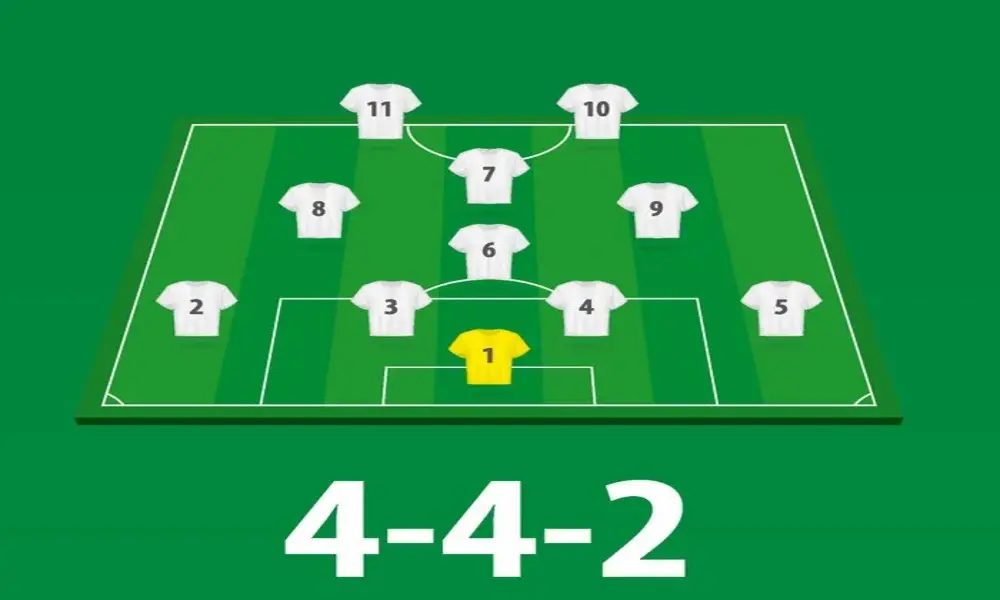
One of its main advantages is its simple structure. Players usually have clear responsibilities, making it easier for a team to maintain its shape.
The two forwards can work together to create scoring opportunities, while the four midfielders provide support in both attack and defense.
4-2-3-1 Formation
The 4-2-3-1 formation consists of four defenders, two defensive midfielders, three attacking midfielders, and one striker.
It gives a team extra protection in central midfield while still providing several attacking options. The three attacking midfielders can move around the striker and create opportunities.
This formation can be useful for teams that want defensive stability without giving up their attacking threat.
3-4-3 Formation
The 3-4-3 formation uses three central defenders, four midfielders, and three attacking players.
Wing-backs are particularly important in this system because they have to contribute both defensively and offensively. When the team attacks, they can move forward to provide width. When the team defends, they can drop back and create a five-player defensive line.
The 3-4-3 can create strong attacking options but requires players to understand their positions and responsibilities.
5-3-2 Formation
The 5-3-2 formation provides a strong defensive structure with five defenders, three midfielders, and two forwards.
Wing-backs can move forward when the team has possession, allowing the formation to become more attacking. Without the ball, the team can create a compact defensive shape.
This formation can be useful when a team wants to protect a lead or defend against strong attacking opponents.
How to Choose the Right Football Formation
Choosing the right football formation depends on several factors. Coaches need to consider the strengths of their players, the style of the opposition, and the objectives of the match.Players can also improve their overall skills with these football training tips.
For example, a team with strong wingers may benefit from a formation that gives them freedom to attack from wide areas. A team with excellent midfielders may prefer a system that provides more control in the center of the pitch.
The best formation is not always the most attacking or defensive one. It is the formation that allows the players to perform their roles effectively.
Importance of Football Formation
A good formation gives players a clear understanding of where they should be on the pitch. It can help improve communication, defensive organization, passing options, and attacking movement.
Formation also helps teams maintain balance. If too many players move forward at the same time, the team may become vulnerable to counterattacks. A well-organized formation helps maintain defensive cover while allowing players to support attacks.
Football Formation and Tactics
Formation and tactics are closely connected, but they are not exactly the same thing. A formation shows the basic positioning of players, while tactics describe how those players behave during the game.
For example, two teams can use a 4-3-3 formation but play completely different styles. One team may focus on possession and short passing, while another may rely on quick counterattacks.
This is why looking only at a formation does not always tell the complete story of how a team plays.
Conclusion
Understanding football formation is important for players, coaches, and fans. Formations such as 4-3-3, 4-4-2, 4-2-3-1, 3-4-3, and 5-3-2 give teams different ways to organize themselves on the pitch.
There is no single formation that is perfect for every team. The right choice depends on the players, opponent, tactics, and match situation. By understanding how different formations work, football players can improve their positioning and teamwork, while fans can gain a better understanding of the tactical side of the game.